Charlestown Route 12 Repair Update – April 19, 2022
Dear Elected Officials for Charlestown, Walpole, and Claremont:
Last Wednesday evening NHDOT Assistant Commissioner Bill Cass and Project Manager Jason Ayotte attended the Charlestown Selectboard meeting. Jason Ayotte presented an overview on the Charlestown Rt. 12 repairs: what caused the road closure, the prior plan, why the prior plan was not workable, and the plan going forward. Assistant Commissioner Cass and Project Manager Ayotte answered a variety of questions, including the location of drainage, availability of materials, and the construction schedule.
We do not believe it would be safe for public use of the road during construction and it would hinder the work. However, at the request of the Police Chief, the Department and contractor will provide emergency access for emergency vehicles during off-hours of construction.
The immediate repair is underway. The contractor, Casella, has remobilized and ordered the necessary materials, with some materials being delivered to the site last week. Casella was back on site and working yesterday, April 18, 2022. It is anticipated the work will take 6 weeks. With no weather delays, the road should be reopened by the end of May 2022.
As previously stated, the immediate repair is an interim, subject to the same conditions and issues that cause the road to be closed. Additional drainage work is planned, which will improve conditions to some degree. DOT will continue to monitor the roadway while the alternatives analysis is being done to determine a long-term solution. This long-term solution will be the future Ten Year Plan project.
In the meantime, I will continue to send updates. Feel free to reach out to me with any questions.
LCHIP provides grants for helping to maintain our treasured landmarks and historic buildings. An informational webinar will be held on April 18. Thanks to all the dedicated volunteers who maintain the treasures of New Hampshire. ~ Steve
From LCHIP:
In April we welcomed Cassie Bernyk to the LCHIP team as our Operations Coordinator. Cassie, whose friendly voice will be answering phones at LCHIP, is tasked with keeping the entire LCHIP operation running smoothly and efficiently – quite a job! Welcome, Cassie!
April kicks off the official start of LCHIP’s annual grant cycle. On April 18th we’ll host our webinar for new (or repeat) grant applicants – providing an overview of our grant programs, and an introduction to LCHIP’s grant management system. To register (required) contact Cassie Bernyk at Officemgr@lchip.org or 603-224-4113.
Those planning to seek LCHIP funding in 2022 should also note that Letters of Intent are due May 18th. Organizations invited to apply will be required to submit full proposals by June 22, with funding decisions announced in mid-November. More information on LCHIP’s 2022 grants can be found here.
Best,
Paula Bellemore
Executive Director
OVERVIEW
Since 2001, LCHIP has proudly awarded $54 million dollars to 364 organizations in 179 communities across New Hampshire to conserve and preserve New Hampshire’s most important natural, cultural and historic resources. In 2022, LCHIP will be accepting applications from eligible applicants for natural resource acquisition, historic rehabilitation, and historic preservation planning grants.
Preservation Planning Grants To support the study of eligible historic resources.
Historic Rehabilitation Grants To support the restoration or rehabilitation of eligible historic resources.
Natural Resource Acquisition Grants To support the permanent protection of ecologically significant lands.
2022 GRANT ROUND SCHEDULE
Grant Round Opens
May 1, 2022
Letter of Intent Due
May 18, 2022
Applications Due
June 22, 2022
Funding Decisions
Mid-November 2022
ELIGIBILITY
An organization applying for LCHIP funding must be either a municipality or other political subdivision of the state of New Hampshire, or be a publicly supported nonprofit corporation exempt from federal income tax under section 501 (c) of the Internal Revenue code. Other interested parties may partner or work with an eligible organization or government entity but may not apply directly through LCHIP.
New in 2022! A representative from the applicant organization must attend a 2022 LCHIP Grant Orientation Workshop prior to submitting a proposal. Workshops will be delivered via Zoom webinar, and are recorded and available for viewing at your convenience.
Webinar: Monday, April 18, 2022 at 10am. Please email Cassie to RSVP: officemgr@lchip.org.
Program-specific eligibility requirements are described in the following guidance documents:
New in 2022! Letters of Intent and Proposals must be submitted through LCHIP’s grant portal. Access to the grant portal will be available by May 1, 2022.
Prospective applicants must submit a Letter of Intent through LCHIP’s online grant management portal describing the project for which they intend to seek LCHIP funding. LCHIP staff will review the information provided for compliance with LCHIP’s eligibility criteria. All eligible projects will then be invited to submit a complete proposal.
The proposal includes the application and several required attachments which are submitted through LCHIP’s online grant management portal. Detailed instructions on how to complete the application and additional guidance materials are provided within the portal.
A Review Panel comprised of experts in various elements of natural- and historic-resource conservation will review all proposals and conduct site visits to project sites in order to gain a better understanding of each project. The Review Panels provide recommendations to the Board of Directors, which is responsible for making the final funding decisions.
Each organization receiving an LCHIP award is required to enter into a Project Agreement with LCHIP. The Project Agreement summarizes the obligations of the Grant Recipient and LCHIP, and outlines the project’s scope, structure and purpose as understood by LCHIP. To accept an LCHIP Award, an authorized representative of the recipient organization must sign and return the Project Agreement by the established deadline.
If a proposal is not funded, a representative of the applicant organization will be invited to meet with LCHIP staff to discuss the project and proposal. The goal of these meetings is to assist applicants to identify ways in which the project or proposal could be strengthened in the future. There is no prohibition against resubmitting an improved proposal for the project in future LCHIP grant rounds.
Dear Elected Officials of Charlestown, Walpole, and Claremont:
Work to construct the soil nail wall was halted due to movement of the rail lines and excessive groundwater at the construction site. The movement, recorded by the devices installed prior to construction beginning, caused the railroad to lower speeds to 10 mph for the Amtrak and freight trains.
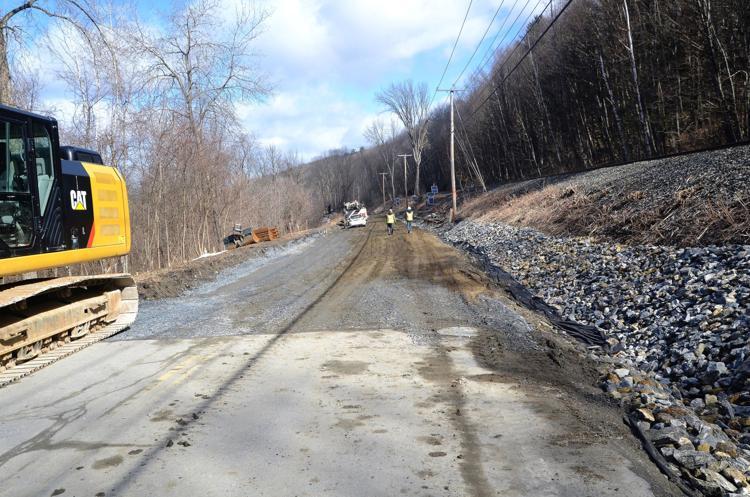
The attached photos of the soil nail wall construction depict the issues created by the excess water. And while it may seem logical to de-water (removing the excess water by pumping), dewatering could lead to additional settlement of the rail tracks. De-watering may remove silty soil with the water, as well as creating more instability by leaving voids in the railroad embankment.
The Department has been actively working with the Railroad, the consultant, and the contractor to develop the best approach to repair Charlestown Rt. 12 with the poor soil strengths, high groundwater, and settlement experienced. As the contractor was conducting initial tests, it was found the soil did not have the required strength. In order to stabilize the embankment without dewatering, other more extensive retaining wall options were conceptualized; however all were determined to be cost prohibitive.
The Department is proposing a two-phased approach with a short-term and a long-term solution. The short-term solution would reopen Charlestown Rt. 12 in the interim. This approach was discussed last week with the Railroad, which was amenable to this short-term solution. Under the short-term plan, the current soil nail wall will be discontinued. The embankment will be stabilized. The road will be built back up with fill and gravel and paved so that the two-lane section of Charlestown Rt 12 can be re-opened. Although the Department considered opening a one-lane roadway, any future work to construct a second lane would require closures. Additionally, the roadway is not wide enough for construction equipment, workers, and vehicles to pass safely. (Attached photos show the constrained space.) It is a relatively short section of road to build back up and should proceed fairly quickly.
The re-opening of Charlestown Rt 12 is considered a temporary solution, as the conditions that caused the road closure still exist and poor soils will not be removed. The Department will install monitoring equipment to observe the conditions but cautions that the same situation could arise with another major weather event. The short-term solution would be the route until the long-term solution can be designed and implemented. This will likely involve full reconstruction and consideration of realignment alternatives to increase the distance between the road and the Railroad.
The long-term solution will be investigated within the comprehensive Ten-Year Plan project. The Department has already selected a consultant and initiated the scoping to determine the alternatives available. The efforts to date will be valuable in weighing the alternatives and investigations to determine the best location for NH Route 12.
A change order will be required, and the Department and consultants are working diligently to prepare revisions and minimize the contractor’s downtime. The Project Manager will meet with Town officials and other interested parties for further discussions on schedules, cost, and other pertinent information.
I will update you on further developments in the next 7-14 days.






 NH State Representative Steven Smith
You must be logged in to post a comment.