How The Taxpayer Protection Act (HB 1300) Works

How The Taxpayer Protection Act (HB 1300) Works

HB 1300, The Taxpayer Protection Act lets voters decide directly on their local ballots whether to place taxing limits on their local school systems. State funding of education is at high levels. Despite this Granite Staters have seen no property tax relief. On top of that, we are one of the highest spending per pupil states to the country. We spend more than $1 billion per year on public education. We don’t have a revenue problem we have a spending problem and HB 1300 to get the spending under control

What does this Bill do?

At the state general elections in November 2026 and November 2028, every town and city ward in New Hampshire will automatically have a question on their ballot.

This is on the November ballot because it is when voter participation is the highest. This guarantees maximum electorate participation compared to March when turnout can land in the single digits.

Voters will decide whether to approve two, two-year caps:

1. A School District Tax Cap which limits how much school property taxes can increase).

2. An Administrative Budget Cap which limits central office administrative spending to 6% of the school budget.

To pass, a cap requires a 60% (three-fifths) majority vote of approval from local voters just like in regular town meetings/elections.

What Exactly the Question is:

For towns and wards with an annual school district meeting, the official question on your ballot will read exactly like this:

“Shall the [name of municipality] limit property tax growth for [name(s) of school district(s)] under RSA 32:5-i? If adopted for a two-year period: (1) the local property tax levy may not grow beyond the prior year’s amount, adjusted for inflation and new construction; (2) SAU central office spending may not exceed 6 percent of total school district appropriations; and (3) bonded capital costs are excluded from both limits. These caps apply only to administrative operations of the SAU central office and do not affect classroom instruction, school-based services, or other municipal expenditures. These limits may be overridden as provided in RSA 32:5-i. Adoption requires a three-fifths (3/5) majority vote.”

Why This Is a Good Thing (The Case for HB 1300)

● Direct Taxpayer Relief: It provides local property taxpayers—especially seniors on fixed incomes and young families—with immediate, predictable protection from rapidly rising property tax bills.

● True Local Control: Instead of leaving big financial decisions to low-turnout annual school meetings or complex petition processes, it puts the decision directly into the hands of the largest possible number of local voters on a high-turnout November ballot.

● Targets Bureaucracy, Protects Classrooms: The 6% cap ensures that local tax dollars are spent where they matter most, on teachers, textbooks, and students,rather than on expanding administrative overhead and central office bureaucracy.

● Keeps a Safety Valve: The bill does not lock communities into rigid, unbreakable limits; if a school district faces a genuine emergency, voters or local officials can easily vote to override the caps.

Don’t let the partisan rhetoric distract you: HB 1300 doesn’t force a single cap on anyone, it simply trusts you, the voter, to make the choice for your own town.

The School District Tax Cap

This cap protects property taxpayers by limiting how much a school district can increase its tax levy from one year to the next.

● What is capped:

○ The overall amount of local property taxes collected to run the school district.

● What is NOT capped (Allowed Increases):

○ Inflation: Taxes are allowed to rise to match the rate of inflation (using the Northeast Consumer Price Index).

○ New Construction: Taxes can increase to cover new home building, physical expansions, or property developments in town.

○ It does not cap increases due to general real estate market revaluations.

The 6% Administrative Cap

This cap is designed to limit school district overhead and “bureaucracy” without touching classrooms.

● What is capped at 6%: Central SAU office expenses only. This includes superintendent and assistant superintendent salaries, HR, central finance, payroll, purchasing, district-level IT, and public relations.

● What is NOT capped (Protected Services):

○ Classroom Instruction: Teachers, classroom materials, and textbooks.

○ School-Level Operations: Principals, school-based staff, and janitorial/building maintenance.

○ Student Services: Special education, school lunches, and student bus transportation.

Building Construction & Bonds (Always Excluded)

● School Buildings & Debt: Any property taxes used to pay off bonds or loans for purchasing land, building new schools, or major building renovations are completely exempt from both caps. Long-term infrastructure investments are fully protected.

Can the Caps Be Overridden?

Yes. If a local school district faces an urgent financial need, the community is not locked in.

The caps can be bypassed:

● In Towns with School District Meetings: Voters can override the cap with a 60% majority vote on a ballot at their annual school meeting.

● In Cities/Towns without School Meetings: The local legislative body (such as the City Council) can override the cap using the supermajority rules in their municipal charter.

Runaway Admin Salaries: Spending Where It Doesn’t Belong

When opponents of HB 1300 claim that school districts are strapped for cash, they ignore the elephant in the room: the ballooning cost of administrative overhead. Across the Granite State, school administrative budgets are being consumed by six-figure salaries for central office bureaucrats. This is money that is being spent on paper-pushing instead of being funneled into classrooms to help students and teachers.

To put this ridiculous spending in perspective, consider this:

● The Governor of New Hampshire, who manages a multi-billion dollar state budget, oversees dozens of state agencies, and represents 1.4 million residents, earns an annual salary of approximately $153,000.

● Yet, in school districts all over our state, local superintendents and top-tier central office administrators routinely bring in $160,000 to over $200,000 a year in base pay alone, before factoring in generous taxpayer-funded benefit packages.

Posted in Uncategorized | Tagged , , , | Leave a comment

Tools for Taxpayers

It seems like however much more money the state spends on education, it never seems to translate into tax relief. It is a difficult dynamic. We set the state budget, but you set your spending locally. We don’t know what it’s going to be. There are some communities where the state pays more than half of the cost of each student. There is at least one school district that has voted locally to spend more than $30,000 per student. Here in Sullivan County, the numbers are much lower. It doesn’t seem right that I take more of your money to subsidize high spending elsewhere.

State Aid

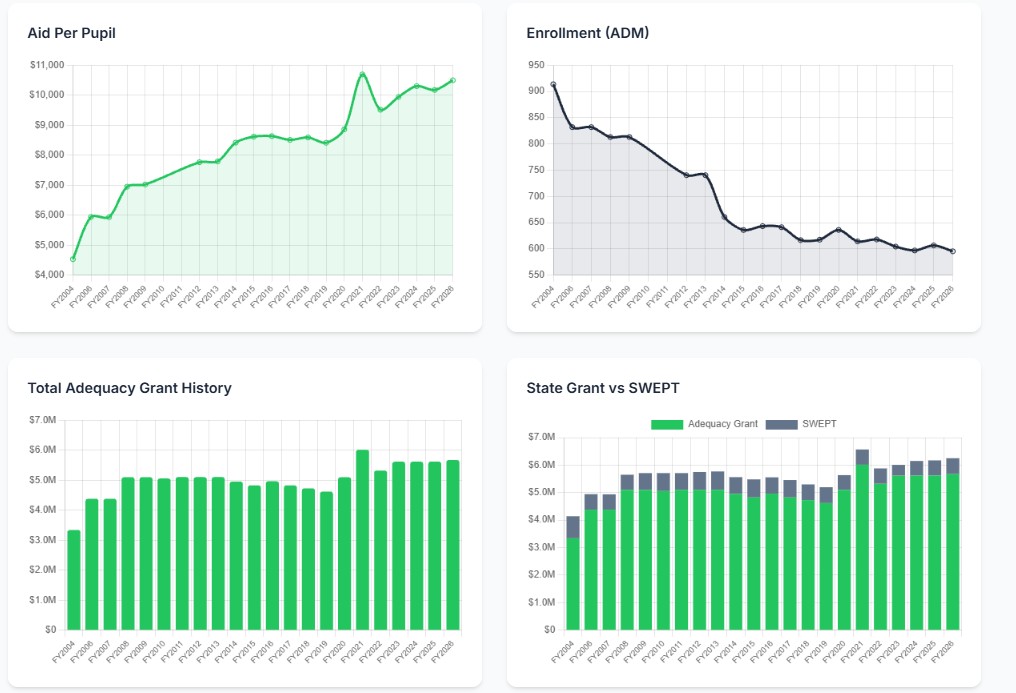
This chart shows how much aid per pupil Charlestown has been getting. Despite declining enrollment, the number goes up.

This is enrollment over the same time period.

The total aid has increased as well, but it won’t help unless we can do something to harness local spending, or at least validate it. Two bills have passed that will give you a little control.

Administration Costs

We believe admin costs, including salaries, have gone out of control. The salaries have certainly increased much faster than teacher salaries. Do you know your local district admin costs?

House Bill 564, which Ayotte signed June 19, requires all school districts to separate the school administrative unit’s budget from the rest of the school district’s budget every year. At their annual town meeting or deliberative session, voters will be allowed to approve or reject that budget as its own warrant article. “ https://nashua.inklink.news/new-law-allows-nh-voters-to-veto-school-administrator-pay-increases You’ll have the flexibility to decide the school budget itself seem reasonable, but the overhead costs are too high. You get more control this way, and at least you’ll know.

Tax Cap

A lot has been said about HB 1300, and most of it misses the point. This bill does not force a tax cap on every school district in New Hampshire. It does not take away local control. It does the opposite. HB 1300 lets the voters in each community decide for themselves whether they want a school property tax cap. You will be able to vote on whether costs should be capped with some certain restrictions. https://nhjournal.com/smith-hb-1300-is-about-letting-voters-decide/ There has been criticism that low voter turnout in local elections dilutes what most voters really want. With this bill, we’re going to find out if that is true. The tax cap question will be on November ballots when most voters go, and certainly more voters than local elections.

Neither of these things will lower costs, but they do give you tools to get them under control. I don’t mean to imply that these tow measures are the solution, but they are a good start into reigning in what can seem like a runaway train of increased taxes.

Steve

Posted in Uncategorized | Tagged , , , | Leave a comment

Connecticut River

UPDATE: DRAWDOWN TO BE INITIATED

As previously indicated, Great River Hydro expects to initiate the drawdown of the Bellows Falls Dam impoundment on the Connecticut River beginning Sunday, April 26.  This timing is subject to change if weather in the interim is materially different than current forecasts.

GRH will slowly lower the impoundment, conduct the necessary dam maintenance work, and then gradually refill the impoundment to normal operating levels. The entire process is expected to take approximately 3 to 4 days. We will communicate with you again when the work is completed.

During the drawdown, visitors to Connecticut River will see exposed riparian areas upstream of Bellows Falls dam, most visible closest to the Bellows Falls dam. We are taking every measure to mitigate, to the extent possible, risks and impact to environmental resources in and adjacent to the Connecticut River.

All recreational use of the river is strongly discouraged during the drawdown period as reduced flows may expose previously submerged hazards and dangerous conditions could exist in exposed mud flats. Public safety devices at the dam will be restored as soon as possible. Boat ramps at the following locations be temporarily closed until that work is completed: Herricks Cove (Rockingham, VT), Charlestown (Charlestown, NH), and Pine Street (North Walpole, NH). 

We would appreciate your assistance in sharing this information within your own local networks or community social media outlets.

Further updates will be provided as soon as possible.  Please contact communications@greatriverhydro.com or (802) 291-8104 with any questions.

Best regards,

Brandon Kibbe

Vice President, External Affairs

Great River Hydro

69 Milk Street, Suite 308

Westborough, MA  01581

www.greatriverhydro.com

Posted in Uncategorized | Leave a comment