Federal Update for June 7

20200304emba750x450Here are some key actions occurring at the federal level. Monitoring these is important as we ensure that New Hampshire’s needs are included. Not every solution works for every state. ~ Steve

President Trump Signs Executive Order on Accelerating the Nation’s Economic Recovery from the COVID-19 Emergency by Expediting Infrastructure Investments and Other Activities: On June 4, President Trump signed an Executive Order that would expedite permitting for infrastructure projects, building on earlier orders to ease regulations for industry. The order directs federal agencies, including Interior, Agriculture and Defense departments and the Army Corps of Engineers, to hasten the permitting processes required under the National Environmental Policy Act, the Endangered Species Act and Clean Water Act. Read more here. On May 19, President Trump signed an Executive Order to slash red tape in order to revitalize the economy and get Americans back to work. Find more on the Administration’s efforts to put people over paperwork here. In response to the COVID-19 pandemic alone, the Administration has taken over 600 regulatory actions, including suspensions, waivers, and enforcement discretions.

HHS Announces New Laboratory Data Reporting Guidance for COVID-19 Testing: On June 4, the U.S. Department of Health and Human Services announced new Guidance that specifies what additional data must be reported to HHS by laboratories along with Coronavirus Disease 2019 (COVID-19) test results. The requirements include demographic data like race, ethnicity, age, and sex. This data will provide information needed to better monitor disease incidence and trends by initiating epidemiologic case investigations, assisting with contact tracing, assessing availability and use of testing resources, and anticipating potential supply chain issues.

HHS Awards $20.3 Million to Expand the Addiction Workforce in Underserved Communities: On June 2, HHS awarded $20.3 million to 44 recipients to increase the number of fellows at accredited addiction medicine and addiction psychiatry fellowship programs. The awardees will train addiction specialists at facilities in high need communities that integrate behavioral and primary care services. These awards demonstrate the Trump Administration’s commitment to help Americans suffering from opioid use disorder and other substance use disorders.  Awardees will invest in clinical training of addiction medicine and addiction psychiatry subspecialists to combat the opioid crisis.

HHS Provides an Additional $250 Million to Help U.S. Health Care Systems Response to COVID-19: On June 2, HHS announced the allocation of an additional $250 million to aid U.S. health care systems treating patients and responding to the COVID-19 pandemic. As authorized by the CARES act, HHS has now provided a total of $350 million to health care systems for pandemic response, including $100 million released in April 2020.

Federal Reserve Updates Terms and Eligibility for Municipal Liquidity Facility: On April 9, the Department of Treasury and Federal Reserve launched a Main Street Business Lending program and a Municipal Liquidity Facility (MLF) to support the flow of credit to American workers, businesses, States, counties, and cities across the Nation impacted by the COVID-19 pandemic. The MLF will provide up to $500 billion in direct financing to States and eligible units of local government (counties with > 500,000 population and cities with > 250,000 population) to help ensure they have the funds necessary to provide essential services to citizens and respond to the COVID-19 pandemic. To expand the availability of the MLF in those States without units of local governments meeting the population thresholds, governors in 20 states now have the ability to designate at least one additional city or county to participate in the program under updated guidelines, which can be found here. according to guidelines issued Wednesday. More information on the MLF can be found here.

DOJ Awards Nearly $400 Million for Law Enforcement Hiring to Advance Community Policing: On June 2, the U.S. Department of Justice announced nearly $400 million in grant funding through the Department’s Office of Community Oriented Policing Services (COPS Office) COPS Hiring Program (CHP). The Attorney General announced funding awards to 596 law enforcement agencies across the nation, which allows those agencies to hire 2,732 additional full-time law enforcement professionals. The awards announced are inclusive of the $51 million announced in May as part of Operation Relentless Pursuit.  

USDA Issues First Coronavirus Food Assistance Program Payments: On June 4, USDA Secretary Sonny Perdue announced the USDA Farm Service Agency (FSA) has already approved more than $545 million in payments to producers who have applied for the Coronavirus Food Assistance program. FSA began taking applications on May 26, and the agency has received over 86,000 applications for this important relief program. The top five states for CFAP payments are Illinois, Kansas, Wisconsin, Nebraska, and South Dakota. Learn more about the CFAP program, which provides $16 billion in direct payments to deliver relief to farmers and ranchers across the country here.

Small Business Administration and Treasury Department Announce $10 Billion for CDFIs to Participate in the Paycheck Protection Program: On May 28, SBA announced that it is setting aside $10 billion of Round 2 funding for the Paycheck Protection Program (PPP) to be lent exclusively by Community Development Financial Institutions (CDFIs).  CDFIs work to expand economic opportunity in low-income communities by providing access to financial products and services for local residents and businesses.  These dedicated funds will further ensure that the PPP reaches all communities in need of relief during the COVID-19 pandemic – a key priority for President Trump. As of May 23, 2020, CDFIs have approved more than $7 billion ($3.2 billion in Round 2) in PPP loans.  The additional $6.8 billion will ensure that entrepreneurs and small business owners in all communities have easy access to the financial system, and that they receive much-needed capital to maintain their workforces. 

FEMA Releases COVID-19 Pandemic Operation Guidance for the 2020 Hurricane Season: In preparing for the 2020 hurricane season, the Federal Emergency Management Agency released guidance to State, local, Tribal, and Territorial officials to help them prepare for response and recovery operations. While the document focuses on hurricane season preparedness, most planning considerations can also be applied to any disaster operation in the COVID-19 environment, including no-notice incidents, spring flooding and wildfire seasons, and typhoon response.

Department of Homeland Security (DHS)

·       DHS Supporting States and Local Governments to Keep Communities Safe: As a department with numerous law enforcement and intelligence capabilities, DHS is taking action to prevent, respond to, and mitigate civil unrest in the United States at the National, State, and local levels. DHS is providing local and State law enforcement with intelligence, information and surveillance assets to track these groups instigating the violence. DHS has also deployed CBP and ICE law enforcement officers to assist partners on the ground. DHS continues to work alongside together federal agencies and the President to restore peace to our streets and neighbors. Contact DHS Intergovernmental Affairs for resources at dhs.iga@hq.dhs.gov and learn more about the Homeland Security Grant Program here.

·       DHS Cyber Security and Infrastructure Security Agency (CISA) Providing Support to State and local Governments: DHS CISA continues to provide support to State and local governments across the country who are responding to the COVID-19 pandemic and current events. On May 29, CISA released the first of six “Cyber Essentials” toolkits to assist State and local officials and private sector stakeholders in establishing a “culture of cyber readiness” that will lead to security investments, risk awareness, and collaboration with trusted third parties. The first of these toolkits is focused on how small businesses can set the right tone for their organization and work with their staff to develop the right policies. Future documents will address asset protection, access control, the importance of backups and incident response and recovery. Also, on May 15, CISA published guidance for 911 centers regarding pandemics. The guidelines aim to assist public safety partners across all levels of government when developing plans and actions regarding governance, procedures, staffing, and cleaning and disinfecting in response to a pandemic.

Department of Justice (DOJ)

·       DOJ Providing Support to State and Local Governments to Keep Communities Safe: As stated by Attorney General Bill Barr, “The greatness of our nation comes from our commitment to the rule of law. The outrage of our national community about what happened to George Floyd in Minneapolis is real and legitimate. Accountability for his death must be addressed, and is being addressed, through the regular process of our criminal justice system, both at the state and at the federal level.” To support State and local governments in maintaining order, all DOJ components have contributed manpower and members of federal workforce have been deputized to allow them to provide peacekeeping functions.

·       DOJ Activates Joint Terrorism Task Forces: DOJ has also responded by activating the existing network of 56 regional FBI Joint Terrorism Task Forces to identify criminal organizers and instigators and to coordinate federal resources with our state and local partners. The JTTFs are well-suited to this task because they combine intelligence and operational resources and federal and local law enforcement. All JTTF command centers are currently operating on a 24/7 basis. Collaboration with operations and intelligence sharing is critical to disrupting the radicalization of violence we continue to see across the country aimed at civilians, peaceful protesters and the law enforcement community.  DOJ and the Administration want mayors to have the conviction to request and utilize all available resources at the State, local and federal level to combat violence and best protect the members of our communities across the country.

·       Additional Information and Resources

·       The President’s Commission on Law Enforcement and the Administration of Justice to ensure trust and accountability of law enforcement in all communities

·       Office of Justice Programs

·       Office of Community Oriented Policing Services (COPS)

·       Grants for State and local law enforcement

Federal Bureau of Investigation (FBI)

·       FBI Providing Support to State, Local, and Federal Law Enforcement Partners: The FBI is supporting State, local, and Federal law enforcement partners with maintaining public safety in the communities they serve. Efforts are focused on identifying, investigating, and disrupting individuals that are inciting violence and engaging in criminal activity. The FBI has stood up 24-hour command posts in each of 56 field offices, as well as a national command post at FBI Headquarters. FBI is supporting with personnel resources upon the request of law enforcement partners. FBI has set up locally based intelligence teams to gather information about criminal activity and violent actors. FBI is soliciting tips, leads, and video regarding criminal activities via the National Threat Operations Center (NTOC). FBI is sharing threat information with partners so to anticipate where law enforcement attention will be needed to ensure the safety of our communities.

Department of Defense (DOD)

·       DOD Providing Support to State and Local Governments: Through the National Guard Bureau, the Department of Defense is helping State and local governments respond to COVID-19 and keep communities safe. The National Guard is part of the communities and is prepared to assist law enforcement in keeping communities safe. To date, 31 state Governors have called up about 30K National Guardsmen in support of the response to protests. This is in addition to the 40K National Guardsmen and women who are providing support in response to the COVID-19 pandemic. The number surpasses the more than 51,000 Guard members activated after Hurricane Katrina struck the Gulf Coast in 2005, which was the Guard’s largest previous domestic response in recent years. Learn more here.

II.          COVID-19 Response and Recovery

COVID-19 Guidance & Resources

Reopening Guidance and Resources: President Trump and the White House Coronavirus Task Force unveiled Guidelines for Opening Up America Again, a three-phased approach based on the advice of public health experts. These steps will help state and local officials when reopening their economies, getting people back to work, and continuing to protect American lives. Please click here for more information: Guidelines for Opening Up America Again

·       Testing Overview (here)

·       Testing Blueprint (here)

·       Guidance for Cleaning and Disinfecting Public Spaces, Workplaces, Businesses, Schools and Homes (here)

·       CDC guidance for CampsChild Care ProgramsSchoolsMass TransitRestaurants And Bars, and Workplaces.

·       CDC Activities and Initiatives Supporting the COVID-19 Response and the President’s Plan for Opening America Up Again (here)

CDC Contact Tracing Resources: Below, find helpful contact tracing information and resources for State, local, and Tribal governments.

·       COVID-19 Contact Tracing Training: Guidance, Resources, and Training Plan (here)

·       COVID-19 Principles of Contact Tracing Booklet (here)

·       Health Departments Interim Guidance on Developing a COVID-19 Case Investigation & Contact Tracing Plan (here)

·       Principles of Contact Tracing: CDC’S Basic Principles of Contact Tracing to Stop COVID-19 Transmission (here)

·       Preliminary Criteria for the Evaluation of Digital Contact Tracing Tools for COVID-19 (here)

·       Digital Contact Tracing Tools for COVID-19 (here)

·       Community-Based Testing Sites: HHS has partnered with pharmacy and retail companies to accelerate testing for more Americans in more communities across the country. This includes helping stand-up more than 300 community-based testing sites in 44 states. Learn more and find a community-based testing site near you here.

·       Funding and Other Resources: HHS and CDC continue to provide States, Tribes, and local governments with important resources to support testing and contact tracing efforts. This includes $11 B announced on May 11. More information about CDC’s ongoing support to States here.

Testing & PPE: Below, find helpful testing information and resources from HHS, the Food & Drug Administration and other federal agency partners.

·       FDA Approved Tests: To date, the FDA has authorize 119 tests under EUAs, which includes 103 molecular tests, 15 antibody tests, and 1 antigen test. You can find the full list here.

·       Public-Private Partnership on Community-Based Testing Sites: HHS has partnered with pharmacy and retail companies to accelerate testing for more Americans in more communities across the country. More details here.

·       U.S. Department of Health & Human Services (HHS) is delivering $11 billion in new funding to support expanded testing capacity for States, territories, and tribes. More information here and you can find the State-by-State breakdown here.

·       Primer on Testing Basics: The FDA issued a Consumer Update, Coronavirus Testing Basics, to provide information about the different types of tests available and the steps involved in obtaining results. More details here.

·       Swab & Media Options: You can find swab and transport media option and flexibilities here.

·       Increase Payment for High-Production Coronavirus Lab Tests: CMS announced Medicare is doubling payment for certain lab tests that use high-throughput technologies to rapidly diagnose large numbers of COVID-19 cases. Additional information here. CMS also pays for COVID-19 specimen collection (additional information here).

·       Reminder – FDA Delegates Authority to States: On March 16, the FDA put in place a policy for states to take responsibility for tests developed and used by laboratories in their states. States can set up a system in which they take responsibility for authorizing such tests and the laboratories will not engage with the FDA. This includes expanding swab options as Colorado as done. More information here.

·       Additional Testing Resources: FDA Frequently Asked Questions (FAQ).

Centers for Medicare & Medicaid Services (CMS)

Protecting Nursing Home Residents and Workers: This week, CMS sent a letter from Administrator Verma & CDC Director Robert Redfield to every Governor from regarding the National Healthcare Safety Network for America’s Medicaid and Medicare-certified nursing homes. As we look ahead to re-open America, CMS and CDC are taking action and urging States to keep nursing home residents safe by focusing testing on nursing homes and other vulnerable populations. States were provided detailed information regarding State-specific data reported from nursing homes. You can find additional information, including guidance around infection control and best practices to protect nursing home residents, here. To protect some of our nation’s most vulnerable citizens, the Trump Administration is taking the following actions:

·       CMS is increasing penalties for noncompliance with longstanding infection control requirements.

·       CMS is ensuring States conduct necessary surveys of nursing homes by tying survey funding to State Survey Agency performance.

·       CMS is continuing the deployment of its network of Quality Improvement Organizations to provide an array of assistance and work with governors to target assistance to facilities that have experience outbreaks.

·       CDC is assessing and providing guidance and technical assistance to improve infection control practices to nursing homes and State health departments.

CMS Issues Nursing Homes Best Practices Toolkit to Combat COVID-19: On May 13, under the direction of President Trump, CMS released a new toolkit developed to aid nursing homes, Governors, states, departments of health, and other agencies who provide oversight and assistance to these facilities, with additional resources to aid in the fight against the coronavirus disease 2019 (COVID-19) pandemic within nursing homes. The toolkit builds upon previous actions taken by the Centers for Medicare & Medicaid Services (CMS), which provide a wide range of tools and guidance to states, healthcare providers and others during the public health emergency. More here.

CMS Unveils Enhanced Enforcement Actions Based on Nursing Home COVID-19 Data and Inspection Results: On June 1, CMS unveiled enhanced enforcement for nursing homes with violations of longstanding infection control practices. This announcement builds on the previous actions CMS has taken to ensure the safety and security of America’s nursing homes as the nation battles coronavirus disease 2019 (COVID-19), and is a key step in the Trump Administration’s Guidelines for Opening Up America Again. The enhanced and targeted accountability measures are based on early trends in the most recent data regarding incidence of COVID-19 in nursing homes, as well as data regarding the results of the agency’s targeted infection control inspections. CMS is increasing enforcement (e.g., civil money penalties (CMPs)) for facilities with persistent infection control violations, and imposing enforcement actions on lower level infection control deficiencies to ensure they are addressed with increased gravity.


Image

Posted in Uncategorized | Leave a comment

COVID Summary June 7

As we continue to reopen, we are going to need federal support to minimize the damage. People lost income through no fault of their own. Businesses lost revenue through no fault of their own. It is up to government to make them whole as much as possible.

~ Steve

household-pulse-survey_6.3.20

NH Gives: Double Your Impact with an Early Gift

NHFPI is a participating non-profit in this year’s NH Gives campaign, which features a one-to-one match for the first $250,000 in total gifts raised. Starting at 6pm on June 9, each donation made to any participating nonprofit will be matched 1:1 up to $1,000 per donation for the first $250,000 given. Your gift of any amount during the NH Gives campaign will help to sustain NHFPI’s work. Visit NHFPI’s NH Gives page to make a donation.

Click to access covid-19-update-06062020.pdf

Posted in Uncategorized | Leave a comment

COVID Summary for June 5

Stay at Home not exactly lifted

Some folks read a headline and misinterpreted what will happen on June 15. It does not all go back to pre-Corona life. Because we went through this difficult period, we are in pretty good shape but still need to be cautious. There will continue to be some conditions/restrictions as we open back up. For a good visual of how fast it can get away from you, check out this timed chart – Selected Global Causes of Deaths Due to Various Causes and COVID-19, Jan-May 2O2O You’ll find COVID down at the bottom. Watch its position as time advances. This is why we have been so cautious, and how it can go wrong quickly. ~ Steve

Governor Sununu Issues Executive Order 2020-10

Fourth Extension of State of Emergency Declared in Executive Order 2020-04

https://www.governor.nh.gov/sites/g/files/ehbemt336/files/documents/2020-10.pdf

NH’s stay-at-home order is in effect until June 15. At that time, the Governor said, “It is our intent to allow the stay-at-home order to sunset.”

He also announced Phase 2 of Seacoast Beaches Reopening. This will allow for sunbathing and other traditional beach activities on seacoast beaches effective immediately.

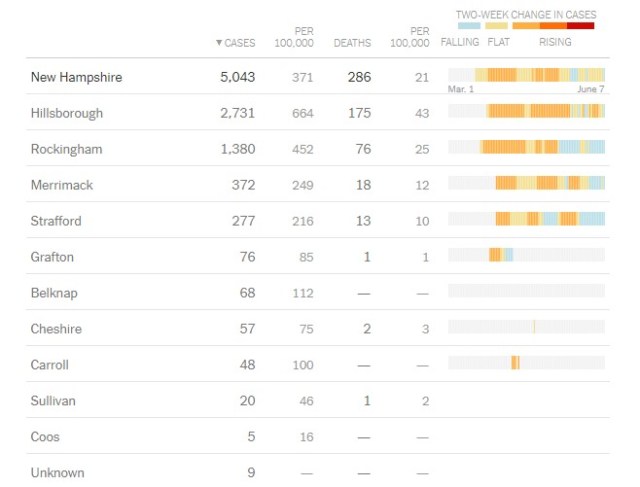
Starting June 15, restaurants can begin serving customers indoors. But in four counties – Rockingham, Hillsborough, Strafford and Merrimack – capacity will be limited to 50%.

  • Starting Friday receptions can now be held, but venues must be at no more than 50% capacity.
  • Overnight summer camps can open June 28.
  • Outdoor and natural attractions can open immediately.
  • Out-of-state residents can now play golf here.

NH restaurants, with restrictions, can open soon for indoor dining; reduced-capacity weddings OK’d

“New Hampshire restaurants will soon be able to open for indoor dining, but their capacity will depend on where they are.

Gov. Chris Sununu said Friday that starting June 15, restaurants can begin serving customers indoors. But in the four New Hampshire counties hardest hit by COVID-19 — Rockingham Hillsborough, Strafford and Merrimack — capacity will be limited to 50%.”

https://www.wmur.com/article/new-hampshire-coronavirus-update-june-5-2020/32780896

Governor Sununu, DHHS Announcements on June 5th

This evening, Governor Sununu and NH DHHS made several important announcements, you can read more about them here:

DHHS Update for June 5

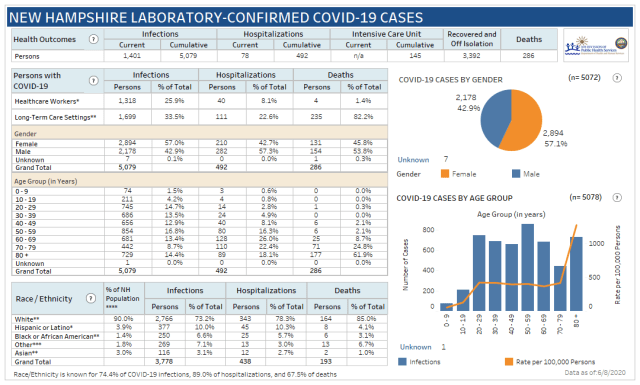
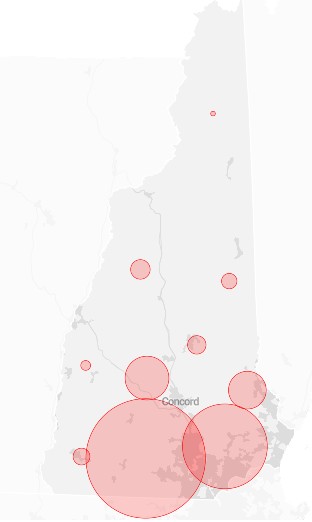
DHHS announced 80 new positive test results for COVID-19. There have now been 4,953 cases of COVID-19 diagnosed in New Hampshire. Several cases are still under investigation. Additional information from ongoing investigations will be incorporated into future COVID-19 updates. Of those with complete information, there are four individuals under the age of 18 and the rest are adults with 68% being female and 32% being male. The new cases reside in Hillsborough County other than Manchester and Nashua (16), Merrimack (10), Rockingham (10), and Belknap (3) counties, and in the cities of Manchester (26) and Nashua (14). The county of residence is being determined for one new case.

Four new hospitalized cases were identified for a total of 476 (10%) of 4,953 cases. Seven of the new cases have no identified risk factors. Community-based transmission continues to occur in the State and has been identified in all counties. Most of the remaining cases have either had travel to domestic or international locations or have had close contact with a person with a confirmed COVID-19 diagnosis.

DHHS has also announced 5 additional deaths related to COVID-19. We offer our sympathies to the family and friends.

  • 2 female residents of Hillsborough County, 60 years of age and older
  • 3 male residents of Hillsborough County, 60 years of age and older

NH Persons with COVID-19         4,953

  • Recovered                                       3,247 (65%)
  • Deaths Attributed to COVID-19   278 (6%)
  • Total Current COVID-19 Cases     1,428
  • Persons Who Have Been Hospitalized for COVID-19        476 (10%)
  • Current Hospitalizations              89
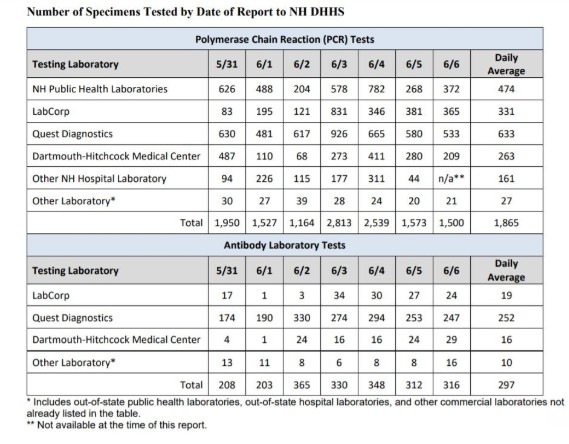
  • Total Persons Tested at Selected Laboratories, Polymerase Chain Reaction (PCR)     82,171
  • Total Persons Tested at Selected Laboratories, Antibody Laboratory Tests               13,292
  • Persons with Specimens Submitted to NH PHL   27,884
  • Persons with Test Pending at NH PHL     1,369
  • Persons Being Monitored in NH (approximate point in time)      3,975

currentoutbreak

closedoutbreak

0605test

0605map

Main Street Relief Fund

  • Main Street Relief Fund – June 5, 2020 – June 12, 2020
  • Grant Application Filing Period: June 5, 2020 – June 12, 2020

Governor Sununu has authorized the allocation and expenditure of $400 million from the CARES Act Coronavirus Relief Fund (“flex funds”) to provide emergency financial relief to support New Hampshire small, for-profit businesses due to the economic disruption caused by COVID-19.

For a small for-profit business to qualify, they must:

  • Have submitted a Prequalification Application

  • Be a for-profit business

  • Have its principal place of business in New Hampshire

  • Have been in operation for at least one year prior to May 29, 2020

  • Anticipate a loss of revenue for 2020 due to COVID-19

  • Have total 2019 gross revenues of less than $20,000,000

  • Not currently be in bankruptcy

  • Not have permanently ceased operations

In addition, the following types of businesses are not eligible for grants under the Main Street Relief Fund as those businesses are or will be addressed through other programs:

  • Nonprofits

  • Childcare providers

  • Hospitals or other healthcare providers

  • Institutions of higher education

  • Elementary or secondary schools

  • Farmers, growers, or maple producers

  • Franchises or national chains

  • A business where the only employees are owners of the business

Complete your Final Grant Submission here

Important Dates & Timeline

  • Announcement of Program Specifics – June 5, 2020

  • Formal Application Period – June 5, 2020 – June 12, 2020

  • Deadline to File Completed Application – June 12, 2020

The Main Street Relief Fund is only available to businesses that submitted a Prequalification Application. All prequalification applicants have received an email directing them to the Final Grant Submission web form. All businesses that submitted a Prequalification Application may complete a Final Grant Submission; however, only businesses that meet all of the Main Street Relief Fund grant criteria are eligible to receive an award. No action is required at this time if prequalification applicants do not wish to participate in this program.

The Main Street Relief Fund Grant award amounts will be calculated based on the grant formula determined by using the information provided by small businesses in their Prequalification Applications. The State of New Hampshire is not directing businesses on how to spend the money. Businesses must demonstrate they have experienced or anticipate they will experience a financial loss due to COVID-19 in order to qualify for a Main Street Relief Fund Grant. It is expected that businesses will use the funds to assist in covering their operational costs and legal obligations.

The Final Grant Submission must be completed and submitted by 11:59 PM on Friday, June 12, 2020, using only the DRA web portal. It is recommended that submissions be finalized as early as possible before the deadline. Businesses that require assistance from the DRA may contact the Call Center, which is available at (603) 230-5000, Option 0, from 8:00 AM to 4:30 PM, Monday through Friday.

To determine the grant amount for an eligible business as part of the Main Street Relief Fund program utilize the below Grant Formula:

  • Step 1.    Calculate the business’s anticipated gross loss, by subtracting estimated 2020 gross receipts from actual 2019 gross receipts (“anticipated gross loss”).
  • Step 2.    Subtract 50% of the Paycheck Protection Program (PPP) amount and 100% of all other federal funds from the anticipated gross loss (“qualified loss”).
  • Step 3.    Sum the qualified losses of all businesses (“total qualified loss”).
  • Step 4.    Divide the total fund balance of $400M by the total qualified loss (“pro rata percentage”).
  • Step 5.    Multiply the pro rata percentage by a business’s qualified loss.
  • Step 6.    If the result of the previous step is above $350K, the business will only receive $350K; in all other cases, the business receives the amount calculated in Step 5.

View Main Street Relief Fund Final Grant Submission Frequently Asked Questions

Main Street Relief Fund Prequalification Information


Posted in Uncategorized | 2 Comments