COVID Summary for 4/3

Two new executive orders came out yesterday. One is simply an extension because orders are only good for three weeks. The other is an order to provide relief from interest on unpaid property taxes. You can read them here:
The Dept. of Employment Security seems to have gotten the website straightened out. They deserve some credit. An agency that is used to handling a few hundred clients per week, suddenly had to ramp up to handle tens of thousands. If you have a doubt whether you qualify for benefits, the best method to find out is to apply online and just answer the questions honestly. A lot of rules have been relaxed. I talked with someone recently who was hesitant to take the money. Please remember, there is no state or federal money. There is no “government” or “public” money. It is YOUR money and there is nothing wrong with getting some of it back. – Steve
hwf
I have no idea if this works, but why not experiment? Many firms are working on apps that help you screen yourself by asking specific questions. Apple has one, and this one is free from the CEO of Pinterest and works on IOS and Android.


NH DHHS COVID-19 Update – April 3, 2020
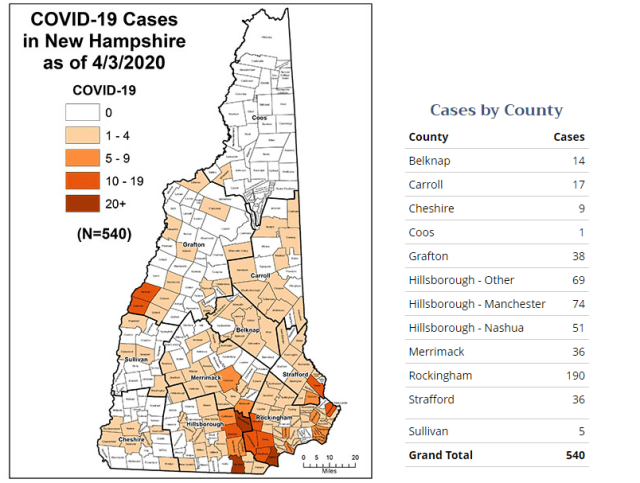
On Friday, April 3, 2020, DHHS announced 61 new positive test results for COVID-19. There have now been 540 cases of COVID-19 diagnosed in New Hampshire. The new cases are 40 adult females and 21 adult males. The new cases reside in Rockingham (20), Hillsborough County other than Manchester and Nashua (12), Belknap (3), Merrimack (3), Carroll (1), Cheshire (1), Coos (1), and Strafford (1) counties, and in the cities of Manchester (11) and Nashua (8). This marks the first confirmed case in Coos County.
Hospitalizations
 

Seven of the new cases were hospitalized for their illness; thus far, 80 (15%) of the 540 positive cases have been hospitalized.


Community Based Transmission
Twenty one of the new cases have no identified risk factors. Community-based transmission continues to increase in the State and has been identified in all counties with cases. Most of the remaining cases have either had travel to domestic or international locations or have had close contact with a person with a confirmed COVID-19 diagnosis.
 
Total number of cases with no identified risk factors is now more than 211, which is 39% of total positive tests. More than one out of three positive tests are community spread, with no identified risk factors.
Deaths
 
DHHS has also announced two additional deaths related to COVID-19. These people were one male and one female, both residents of Hillsborough County who were over 60 years old.
Cases by County
Belknap 14
Carroll 17
Cheshire 9
Coos 1
Grafton 38
Hillsborough – Other (towns) 69
Hillsborough -Manchester 74
Hillsborough – Nashua 51
Merrimack 36
Rockingham 190
Strafford 36

Sullivan 5

New Hampshire 2019 Novel Coronavirus (COVID-19) Summary Report

(data updated April 3, 2020, 9:00 AM)

NH Persons with COVID-19 540
Recovered 144 (27%)
Deaths Attributed to COVID-19 7 (1%)
Total Current COVID-19 Cases 389
Persons Who Have Been Hospitalized for COVID-19 80 (15%)
Persons Tested Negative at Selected Laboratories 6,965
Persons with Specimens Submitted to NH PHL 3,813
Persons with Test Pending at NH PHL 94

Persons Being Monitored in NH (approximate point in time) 1,775


NH: 540 positive test results – 7 deaths
MA: 10,402 positive test results – 192 deaths
ME: 432 positive test results – 9 deaths
VT: 389 positive test results – 17 deaths
CT: 4,915 positive test results -132 deaths
RI:  711 positive test results – 14 deaths
NY: 102,870 positive test results – 2,935 deaths
Apr 3 Map
Posted in Uncategorized | Leave a comment

White House COVID-19 National Briefing April 1, 2020

White House COVID-19 National Briefing April 1, 2020

Topline – What You Need To Know

  • Reponses and recovery are locally executed, state managed, and federally supported (Coronavirus (COVID-19) Pandemic: Response and Recovery Through Federal-State-Local-Tribal Partnership). Solutions are coming from all levels of government to this shared challenge. To quote Ambassador Deborah Birx, “As we started and — we will end with it’s communities that will do this. There’s no magic bullet. There’s no magic vaccine or therapy.  It’s just behaviors. Each of our behaviors translating into something that changes the course of this viral pandemic over the next 30 days.”
  • On March 27, President Trump signed the CARES Act into law. The CARES Act allocates over $2 trillion to COVID-19 response efforts.
  • All 50 states, the District of Columbia, five territories and eighteen tribes are working directly with FEMA under the nationwide emergency declaration for COVID-19. In addition, President Trump has approved 3 major disaster declarations for State COVID-19 response. Approved declarations can be found here. It is important that mayors and county commissioners work closely with their local emergency management officials who in turn work closely with state emergency management officials to follow long-established emergency management protocol to track and work key priorities.
  • FEMA and DOD have released guidance for States and territories seeking approval from the President on National Guard Title 32 Status. Pursuant to this approval, the Federal government will fund 100% of the cost share during approved timeframe. The Administration will continue to work with States approved for 100% cost share to assess whether an extension of this level of support is needed. To date, 14 States have received approval (March 22March 28March 30) More information here.
  • As of March 31, at least 1.2 million tests have been completed around the country with an average of 100,000 samples per day (and climbing). As of today, FDA has approved 20 different emergency testing options. For additional information on testing, the Food & Drug Administration has setup a testing website. The website offers frequently asked questions relating to the development and performance of diagnostic tests for COVID-19, including information on what commercial laboratories are offering testing, utilizing alternative swab supplies/methods (flexibilities in the types of swabs your healthcare professionals can use), diversification on the types of reagents that can be used, etc.
  • Federal agencies are working to increase supplies of personal protective equipment (PPE) through new acquisition, DOD allocation, increasing production, and ensuring effective strategies to appropriately manage important resources . The Administration – led by FEMA – is also marshalling resources from the private sector – and the response from the private sector has been tremendous. (See Op-Ed from Peter Navarro – How Businesses Are Stepping Up, Collaborating with Trump Administration; Washington Examiner – Team USA: 50 Companies Join Trump’s War on Coronavirus).
  • The Centers for Medicare & Medicaid Services (CMS) has issued an unprecedented array of temporary regulatory waivers and new rules to equip the American healthcare system with maximum flexibility to respond to COVID-19. Made possible by President Trump’s recent emergency declaration and emergency rule making, these temporary changes will apply immediately across the entire U.S. healthcare system for the duration of the emergency declaration. More information here.
  • On Sunday, March 29, Vice President Mike Pence wrote a letter to America’s hospital administrators thanking them for their tireless efforts to provide healthcare to Americans during this unprecedented pandemic and outlined the Administration request that hospitals provide information on daily testing, daily counts of patients, availability of hospital beds, and availability mechanical ventilators.

COVID-19 Update and Overview – Dr. Anthony Fauci (Director, National Institute of Allergy and Infectious Diseases)

  • On Tuesday, March 31, the White House Coronavirus Task Force issued revised guidelines – 30 Days to Slow the Spread (Español)– for an additional 30 days. Even if you are young and otherwise healthy, you are at risk, and your activities can increase the risk of contracting the Coronavirus for others. Everyone can do their part. The recommendations are simple to follow but will have a resounding impact on public health.
  • States, Tribes, and localities must continue to do their part to implement the guidelines and proper mitigation efforts.
  • Over the next two weeks, we need to be prepared for things to get worse before they get better. There are early indications that mitigation efforts are making a difference, so now is the right time to double-down and not let up to keep bending the curve down.
  • Models are based on assumptions. We can “anticipate” but “do not need to accept” the forecasting of these models. Everyone needs to do their part and intensively adhere to the guidelines.
  • We must continue to take proper precautions even after the number of new cases begins to stabilize and the curve begins to move in the right direction.
  • “We are an extraordinary nation…[and response] will require the American people to pull together.”

Economic Update and Overview – Larry Kudlow (Assistant to the President for Economic Policy & Director, National Economic Council)

  • The first priority of the President and Administration is the health and safety of the American people. The economy returning back to normal depends on how quickly the country can flatten the curve.
  • Key components of fiscal relief are unemployment insurance, unpaid leave support, and small business payroll retention.
  • The CARES Act provides American families, healthcare workers, and small businesses with the economic support they need to get through this challenging time (See White House Fact SheetSee Op-Ed from Ivanka Trump – Emergency Relief Bill Will Help America’s Small Businesses). The $2.2 trillion economic relief package includes:
  • $1,200 tax free payments (treated as refundable tax credits) to Americans;
  • $150 billion in direct aid to State, Tribal, and local governments;
  • $340 billion in additional emergency supplemental funding to combat the coronavirus outbreak.
  • $500 billion for loans and guarantees that authorize the U.S. Treasury to support eligible businesses and States and local governments to cover losses incurred as a result of COVID-19;
  • $100 billion for hospitals and health care facilities to reimburse expenses or lost revenues not otherwise reimbursed that are directly attributable to COVID-19;
  • $3.5 billion to allow States to expand childcare benefits for healthcare workers, first responders, and others on the frontlines of this crisis.
  •  “When we get to the other side, the economy will resume its upward course.”

CARES Act Implementation – State, Local, and Tribal Government Assistance

  • The U.S. Department of the Treasury has setup a website with up-to-date guidance on CARES Act implementation.
  • States, territories, eligible units of local government, and Tribal governments will receive funds from the Coronavirus Relief Fund. Treasury expects that the $150 billion provided to the Fund will be distributed no later than April 24.
  • Distributions will generally be based on population, with a floor of $1.25 billion for the 50 states. Population data will be drawn from the latest vintage of the Census Bureau’s Population Estimates Program.
  • Treasury is developing a website portal for units of local government to apply for direct funding equal to 45% of its pro rata share of the state’s allocation. Guidance will be provided regarding what jurisdictions are eligible.
  • Funds distributed are an advance against eligible COVID-19 expenditures above budgeted amounts. Guidance on eligible expenditures is expected to be provided in the coming weeks; Treasury understands that recipients of funds need this guidance before disbursements are made.
  • Treasury sees no prohibition on states providing funds to sub-grantees, but the use of funds by sub-grantees must meet statutory use provisions
  • Treasury is partnering with the Bureau of Indian Affairs of the Department of the Interior in conducting Tribal Consultations. The first Consultation will be held on Thursday, April 2.
  • Treasury welcomes the partnership with state and local leaders in the implementation of this fund.

Individual, Small Business and Unemployment Assistance Update

  • The Internal Revenue Service has setup a website with up-to-date guidance to help taxpayers, businesses and others affected by the coronavirus.
  • Distribution of economic impact payments to individuals will begin in the next three weeks and will be distributed automatically, with no action required for most people. Social security recipients, who are not typically required to file a tax return, will automatically receive economic impact payments. For guidance, see Economic Impact Payments: What You Need To Know).
  • The Small Business Administration is offering low interest federal disaster loans for working capital to small businesses and private, non-profit organizations all U.S. States and territories. Learn more here.
  • The CARES Act’s Paycheck Protection Program authorizes up to $349 billion for small businesses to be applies towards job retention and certain other expenses. Small businesses and eligible non-profit organizations, Veterans organizations, and Tribal businesses described in the Small Business Act, as well as individuals who are self-employed or are independent contractors, are eligible if they also meet program size standards.
  • For a top-line overview of the program: Click Here
  • If you are a lender: Click Here
  • If you are a borrower: Click Here
  • For the application for borrowers: Click Here
  • March 28, the U.S. Department of Labor (DOL) published more guidance to provide information to employees and employers about how each will be able to take advantage of the protections and relief offered by the Families First Coronavirus Response Act (FFCRA) when it goes into effect on April 1, 2020. More information here.
  • The Families First Coronavirus Recovery Act (FFCRA), signed by President Trump on March 18, 2020 authorizes the U.S. Department of Labor to disburse $1 billion in grant funding to states for the administration of unemployment insurance programs.  The funding is available to states in two allocations. 23 states have applied for the first round of funding, and DOL is working with the Department of Treasury to certify the funds.
  • Each state administers a separate unemployment insurance program, but all states follow the same guidelines established by federal law. For more information regarding rules in your state, contact with your state’s unemployment insurance program.
  • The FFCRA also authorized emergency paid sick leave and an expansion of the Family and Medical Leave Act. On April 1, 2020, DOL issued a temporary rule codifying in regulation previously issued guidance regarding the implementation of the new leave benefits.
  • The CARES Act, in part, creates the Pandemic Unemployment Assistance Program which provides unemployment compensation benefits for employees traditionally not eligible for these programs (self-employed, independent contractors, and those with limited work history). DOL anticipates additional guidance on the implementation of the CARES Act in the near future.
  • On March 18, DOL announced availability of up to $100 Million in National Health Emergency Dislocated Worker Grants (DWGs) in response to COVID-19.  The DWGs are intended to provide eligible participants with both disaster-relief employment and employment training services. These participants can include dislocated workers, workers who were laid-off as a result of the disaster, self-employed individuals who are unemployed or underemployed as a result of the disaster, and long-term unemployed individuals. Learn more here.

Critical Infrastructure Workforce Guidance Update

  • Functioning critical infrastructure is imperative during the response to the COVID-19 emergency for both public health and safety as well as community well-being. Certain critical infrastructure industries have a special responsibility in these times to continue operations. On Saturday, March 28, the Department of Homeland Security (DHS) – Cybersecurity & Infrastructure Security Agency (CISA) – released updated guidance on the essential critical infrastructure workforce (see Memorandum on Identification of Essential Critical Infrastructure Workers During COVID-19 Response). The list and guidance were initially published on March 16th in response to the COVID-19 epidemic.
  • The guidance and accompanying list are intended to support State, Local, and industry partners in identifying the critical infrastructure sectors and the essential workers needed to maintain the services and functions Americans depend on daily and need to be able to operate resiliently during the COVID-19 pandemic response. Notable additions to the guidance/list from the March 16 release include:
  • Clarification that mining and related critical mineral activity is essential;
  • Clarification that construction activity necessary for infrastructure resilience is essential;
  • Clarification on essential retail activity, particularly as it relates to distribution centers necessary for ecommerce and customer service activity for telecommunications vendors;
  • Clearer recognition of the cross-sector importance of hygiene products and sanitation services;
  • Enhanced detail on enabling functions for critical infrastructure, to include the commodity, services, and logistics supply chains; and
  • The addition of firearm and ammunition manufacturing and distribution as essential
  • State, local, tribal, and territorial governments are responsible for implementing and executing response activities, including decisions about access and reentry, in their communities, while the Federal Government is in a supporting role. Officials should use their own judgment in issuing implementation directives and guidance.

COVID-19: Important Resources for State, Local, and Tribal Officials

  • Coronavirus Guidelines for America: On Monday, March 16, the White House Coronavirus Task Force issued guidelines to help protect Americans during the global coronavirus outbreak. To keep the momentum going to #StopTheSpread and #BendtheCurve, on Tuesday, March 31, the White House Coronavirus Task Force issued revised guidelines – 30 Days to Slow the Spread (Español) – to extend the guidance for an additional 30 days. Even if you are young and otherwise healthy, you are at risk, and your activities can increase the risk of contracting the Coronavirus for others. Everyone can do their part. The recommendations are simple to follow but will have a resounding impact on public health.
  • Up-To-Date Information: The most up-to-date, verified information and guidance can be found via the Centers for Disease Control and Prevention Coronavirus Disease 2019 website – www.coronavirus.gov. The Coronavirus Task Force holds frequent briefings, which can be viewed live here.
  • COVID-19 Response and Recovery Primer: Response and recovery efforts are locally executed, state managed, and federally supported. It is important that requests for assistance, including for critical supplies, get routed through the proper channels as soon as possible. Learn more about the response and recovery process via this important resource – Coronavirus (COVID-19) Pandemic: Response and Recovery Through Federal-State-Local-Tribal Partnership. FEMA’s public assistance guidance for COVID-19 response efforts can be found here. Guidance for Tribal Governments can be found here.
  • Critical Infrastructure Workforce Guidelines: On March 16th, the Department of Homeland Security (DHS) issued updated critical infrastructure guidance in response to the COVID-19 emergency. DHS issued revised guidance on March 28th (see Memorandum on Identification of Essential Critical Infrastructure Workers During COVID-19 Response). The guidance, and accompanying list, is intended to help State, local, tribal and territorial officials as they work to protect their communities, while ensuring continuity of functions critical to public health and safety, as well as economic and national security. The list is advisory in nature and is not a federal directive or standard.
  • Coronavirus Fact vs. Myth: Rumors can easily circulate within communities during a crisis. FEMA setup a website to help the public distinguish between rumors and facts regarding the response to the coronavirus pandemic.
  • Fraud & Scam Protection: The Department of Justice is remaining vigilant in detecting, investigating, and prosecuting wrongdoing related to the crisis. Find out how you can protect yourself and helpful resources on DOJ’s Coronavirus Fraud Prevention website. The Federal Trade Commission has also established a website with helpful information to help consumers avoid coronavirus-related scams.
  • Social Media Resources: Download the Apple COVID-19 Screening Tool. Follow the White House on Twitter and Facebook. Also follow HHS (Twitter/Facebook) and CDC (Twitter/Facebook) You can also find informational videos from Coronavirus Task Force members on mitigation, social distancing, etc. on the White House’s YouTube page.
  • Mental Health Resources: Natural disasters – including such pandemics as the coronavirus outbreak – can be overwhelming and also can seriously affect emotional health. The Substance Abuse and Mental Health Administration’s (SAMHSA) Disaster Distress Helpline – 1-800-985-5990 (or text TalkWithUs to 66746) – provides 24/7, 365-day-a-year crisis counseling and support to anyone who is seeking help in coping with the mental or emotional effects caused by developments related to the coronavirus pandemic.  Learn more about the Disaster Distress Helpline here.
  • Administration Actions and Federal Agency Resources: USA.gov is cataloging all U.S. government activities related to coronavirus. From actions on health and safety to travel, immigration, and transportation to education, find pertinent actions here. Each Federal Agency has also established a dedicated coronavirus website, where you can find important information and guidance. They include: Health and Human Services (HHS), Centers of Medicare and Medicaid (CMS), Food and Drug Administration (FDA), Department of Education (DoED), Department of Agriculture (USDA), Small Business Administration (SBA), Department of Labor (DOL), Department of Homeland Security (DHS), Department of State (DOS), Department of Veterans Affairs (VA), Environmental Protection Agency (EPA), Department of Energy (DOE), Department of Commerce (DOC), Department of Justice (DOJ), Department of Housing and Urban Development (HUD), Department of the Treasury (USDT), Internal Revenue Service (IRS), Office of the Director of National Intelligence (ODNI), and U.S. Election Assistance Commission (EAC).

Graphic labeled requesting critical supplies and personal protective equipment from FEMAGraphic labeled requesting critical supplies and personal protective equipment from FEMAfema


Posted in Uncategorized | Leave a comment

COVID Summary for 4/2

I am trying to keep up with requests for assistance. If are waiting for a reply from me, please call or email. I want to thank everyone who is going to work. While many are prudently staying home, we still need supplies, electricity, fire, police, etc. I was at Market Basket in Claremont last night. An Associate cheerfully pointed that he had cleaned carts ready to go. We were also shopping for a shut in, so we asked for two. He cheerfully pushed them over to us after a final wipe. Most people shopping were giving each other wide berths. Cashiers told people to back up when they were too close to the folks in front of them. Everyone was doing their part, and it was heart warming to see. – Steve

NH DHHS COVID-19 Update – April 2, 2020
On Thursday, April 2, 2020, DHHS announced 64 new positive test results for COVID-19. There have now been 479 cases of COVID-19 diagnosed in New Hampshire. The new cases are 42 adult females and 22 adult males. The new cases reside in Rockingham (17), Hillsborough County other than Manchester and Nashua (12), Strafford (6), Merrimack (4), Cheshire (1), Grafton (1), and Sullivan (1) counties, and in the cities of Manchester (19) and Nashua (3)
Hospitalizations
 

Ten of the new cases were hospitalized for their illness; thus far, 73 (15%) of the 479 positive cases have been hospitalized.

Community Based Transmission
Thirty-seven of the new cases have no identified risk factors. Community-based transmission continues to increase in the State and has been identified in all counties with cases. Most of the remaining cases have either had travel to domestic or international locations or have had close contact with a person with a confirmed COVID-19 diagnosis.
 
Total number of cases with no identified risk factors is now more than 190, which is 38% of total positive tests. More than one out of three positive tests are community spread, with no identified risk factors.
Deaths
 
DHHS has also announced the fifth death related to COVID-19. The person was a male resident of Hillsborough County under the age of 60 years old with underlying medical conditions.
Cases by County

Belknap 13
Carroll 14
Cheshire 8

Coos 0
Grafton 38
Hillsborough – Other 57
Hillsborough – Manchester 63
Hillsborough – Nashua 43
Merrimack 33
Rockingham 170
Strafford 35
Sullivan 5
New Hampshire 2019 Novel Coronavirus (COVID-19) Summary Report
(data updated April 2) 
 
NH Persons with COVID-191 479
Recovered 101 (21%)
Deaths Attributed to COVID-19 5 (1%)
Total Current COVID-19 Cases 373
Persons Who Have Been Hospitalized for COVID-19 73 (15%)
Persons Tested Negative at Selected Laboratories 6,575
Persons with Specimens Submitted to NH PHL 3,672
Persons with Test Pending at NH PHL 114
Persons Being Monitored in NH (approximate point in time) 1,700
 
Regional Information (total positive test results, deaths)
 
NH: 479 positive test results – 5 deaths
MA: 8966 positive test results – 154 deaths
ME: 376 positive test results – 7 deaths
VT: 338 positive test results – 17 deaths
CT: 3,824 positive test results -112 deaths
RI:  657 positive test results – 12 deaths
NY: 92,381 positive test results – 2653 deaths
Governor Chris Sununu Letter to Secretary Mnuchin Regarding CARES Act
 
Governor Chris Sununu sent a letter to Secretary Mnuchin regarding the Coronavirus Aid, Relief, and Economic Security (CARES) Act.  A copy of the letter can be found here.
State Revenues Report
The state’s monthly revenue report was released yesterday (attached). Although total March receipts were only off by about $10 million, it’s fair to say that the worst is yet to come.
Business Taxes for March totaled $98.0 million, which were $17.5 million (15.2%) below plan and $13.1 million (15.4%) above prior year. YTD business tax collections are below plan by $16.7 million (3.4%).
Note: We need that “3.4% below plan” figure not to extend to 6% or below in order to not hit the trigger that would raise the rates of the BPT and BET. The fiscal year ends in June, but the trigger relies on the numbers release in the Comprehensive Annual Financial Report (CAFR) that comes later in the year.
Meals and Rooms collections were above plan, but represent February activity, prior to the emergency declaration.
Worth Watching:
April 2 Case Map
Posted in Uncategorized | Leave a comment